.jpg?w=1200&hash=2996F51E8E74139D16D48B2CE4AED11E)
There are many reasons why Brits are increasingly choosing to purchase homes outside of the route of buying with a romantic partner. From buying with friends or siblings to going it alone, more people are finding alternative paths onto the property ladder.
In fact, according to GOV.UK data, the number of households joint owned by two people outside of a romantic relationship has risen by 9.2% from 2015–16 to 2024–25, reaching 236,000.*
This trend is also reflected in the rise of solo buyers, with 1.95 million homes now owned by single purchasers: a 13.2% increase since 2015–16.
To help those exploring different routes to homeownership, we enlisted Barratt's own mortgage experts and surveyed 1,000 Brits to uncover their opinions on these alternative homebuying options.
Why are people choosing to buy with friends and siblings?
According to our survey, nearly a third of Brits (32%) would be open to buying a house with a friend or sibling. But what were the main reasons behind this?
Speaking on the results, Steve Mariner, Sales and Marketing Director at Barratt Homes, said, “Against the backdrop of ongoing cost of living pressures, affordability concerns dominated the top three factors. These results highlight that Brits are prioritising costs and affordability in the current landscape.
“As the average age of first-time buyers is now 34, choosing to buy with a friend or sibling could help some homeowners move forward with their plans and get onto the property ladder sooner.”
More than a quarter of respondents also said they’d consider buying with a friend or sibling to help them buy a larger property than they could otherwise afford, the same can be said for staying within your original price range and splitting the costs to make homeownership even more affordable.
16% said they would consider buying with friends or siblings to combat loneliness. While buying solo is a fantastic option for those who can do so, moving into a home on your own can be challenging, especially if you’re relocating to a different town or city. Therefore, buying with a friend or sibling can be a great way to avoid some of the potential pitfalls of purchasing alone.
Other key trends highlighted in the survey show that 24% said they would like to avoid renting and believe purchasing with a friend or sibling could help them save money in the long term, while 23% believe it would be easier to secure a mortgage when buying with someone else.
Meanwhile, 22% said they would view an arrangement to buy with a friend or sibling as a temporary step before buying alone in the future, and 16% thought it would be less financially risky than purchasing alone.
What kinds of joint ownership are there?
When purchasing a house with someone, before applying for a mortgage you will have to decide on what kind of joint ownership you are going to enter. There are two types of joint ownership - a Joint Tenancy or Tenants in Common agreement:
- Joint Tenancy: Usually favoured more by those purchasing a home in a married couple or civil partnership, the co-owners have equal shares in the property. In principle, this means that if one of the joint tenants passes away, ownership of the property automatically passes on to the other owner.
- Tenants in Common: More suited to groups of individual buyers such as friends or family, up to four people can enter a Tenants in Common agreement. This allows each of the co-owners to own a share of the property individually, and those shares do not have to be equal. Each party can act independently, meaning they can choose to leave their share to a beneficiary if they wish.
What are the pros of buying with a friend or family member?
While buying with a partner may seem like the most conventional route to home ownership, there are some real benefits for those looking to buy with family members or friends rather than buying solo.
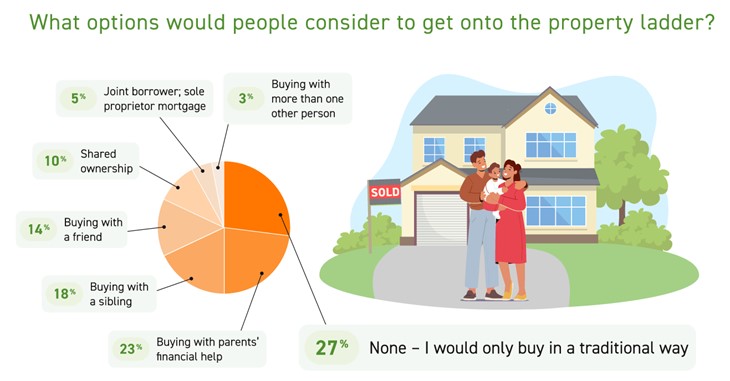
27% of our respondents felt like they would only ever purchase a home through the method of buying with a partner, however the fact that 32% of Brits would be open to purchasing with a friend or sibling suggests that it’s becoming a real consideration for those buying their first homes.
1. Pool your resources for a bigger deposit
One of the biggest advantages of buying a home with a friend or family member is the ability to combine funds, which may allow you to afford a larger deposit and potentially access better mortgage rates.
Sharing financial responsibilities, such as utility bills, insurance, and council tax, can also make homeownership more manageable.
2. Shared responsibilities and companionship
Living with a friend or family member can make day-to-day life easier. Household duties like cleaning can be split, and having a familiar co-owner in the home can help reduce feelings of isolation.
Our survey found that 16% of Brits highlighted companionship as a key reason for purchasing a property with a friend or sibling.
3. Get on the property ladder sooner
For some, saving as a solo buyer can be a more difficult task, as you are the sole person responsible for building the deposit. Buying with someone else means that you can pool your resources allowing you to not only to get on the ladder faster but also increase your buying capability.
Things to consider before buying with a friend or family member
While there are many benefits to buying with a friend or family member, there are also a few important things to consider.
1. Financial risks
When purchasing a house with another person, all owners are responsible for paying the mortgage together. If one person fails to pay, the others must cover the shortfall.
Any financial disputes or issues with mortgage payments can have a knock-on impact on your credit score, so ensuring that you have frank and honest discussions about your finances before signing an agreement is essential.
Any financial disputes or issues with mortgage payments can have a knock-on impact on your credit score, so ensuring that you have frank and honest discussions about your finances before signing an agreement is essential.
You may also find it more difficult to secure other loans in the future, because even though you split the mortgage payments with your co owner, lenders will treat each of you as being responsible for the full mortgage amount. This is the case no matter whether you are tenants in common or have a joint tenancy.
2. Potential relationship strain
While any relationship can change or break down, one of the biggest factors to consider when buying with a friend or family member is that changes in circumstances, such as a new job, relationships, and other life events could lead to one party wanting to move or sell. When buying with a partner, you are often more likely to share the same long-term direction.
3. Legal complications
A Deed of Trust or Cohabitation Agreement is essential when purchasing with friends or family, as it helps protect everyone if disputes arise or if any party does not pay their share. There is also the possibility of one of the co-owners passing away, which could impact the others unless they are protected by a clear legal framework.
What are Brits’ biggest concerns about buying with a friend or sibling?
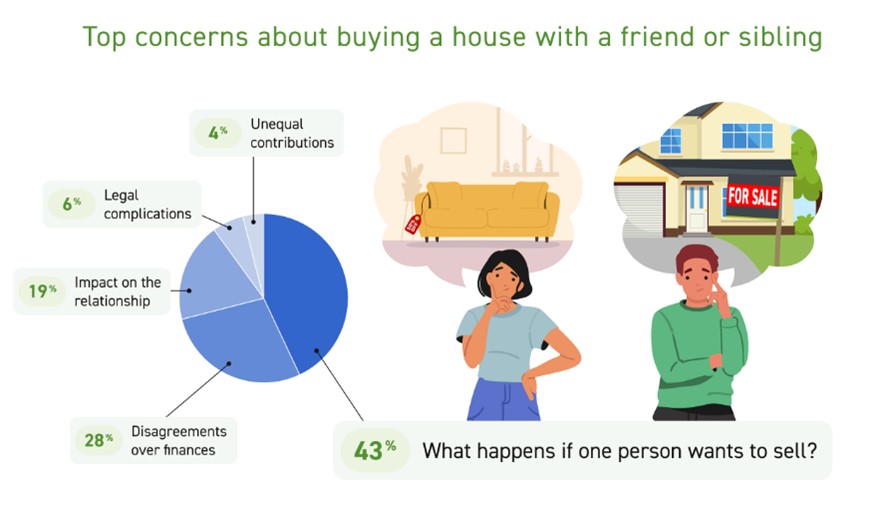
Our survey found that Brits’ biggest concern was what would happen if one person wanted to sell, with 43% citing it as their main concern.
This situation can put a strain on the relationship between the two parties. In this instance, it’s down to the type of agreement you arranged when you first purchased the home, as Adrian MacDiarmid, Head of Mortgage Lender Relations for Barratt Homes explains:
“If a property is owned jointly, both owners need to agree before it can be sold. If one person wishes to remain in the property, they may be able to buy out the other’s share – this often involves remortgaging the property into one name. If neither party can buy out the other, selling and splitting the proceeds is usually the remaining option. A legal advisor can help navigate any disputes.”
Disagreements over household finances were the second biggest concern for 28% of Brits, while the potential impact on the relationship rounded out the top three.
What is a Deed of Trust?
When buying a property with two or more co-owners, a Deed of Trust or cohabitation agreement is crucial, as Adrian explains:
“A Deed of Trust is a legal document that records who owns what share of a property and how sale proceeds should be divided. They can be useful where owners have contributed different amounts to the deposit or mortgage payments.
“A Deed of Trust can also be used to record how mortgage payments are intended to be shared, as well as contributions towards renovations or improvements made at a later stage.
“If a dispute arises in the absence of a Deed of Trust, co‑owners may be treated as having equal ownership, regardless of individual contributions, which could result in one party receiving less than they expected.”
Should you purchase with a friend or sibling or wait to buy solo?
Deciding whether to buy a house sooner with a co-owner or waiting to buy on your own can be a tricky decision and one that depends on a few personal, financial, and lifestyle factors, as Steve explains:
“As with any decision about buying a home, you should weigh up the positives and negatives of either buying solo or with another person. It’s vital that you and the other person have a strong understanding of each other’s financial situation and that you trust them to be open and honest with you, as you will both be responsible for paying the mortgage.
“If you feel confident that you completely trust the person you’re buying with, it can be a fantastic option because it may help you get onto the property ladder faster and potentially afford a home you wouldn’t be able to on your own.
“On the other hand, buying solo can still be a great option for many people, providing full control of the property and sole responsibility for household finances. Before making the decision, it’s important to fully consider your affordability options, and to be aware that it may take longer to save a deposit.”
Ready to take the first step to owning your ideal home? Explore Barratt’s range of new homes and available low deposit schemes to turn your home ownership aspirations into a reality.
Methodology:
Survey of 1,000 Brits about their feelings on different buying options using surveying platform OnePulse. (Data collected February 2026)
*GOV definition of a “lone person” refers to someone not living with a romantic partner.
Sources for ONS data: https://assets.publishing.service.gov.uk/media/6985b1dd6da2dee8230a9b0e/2024-25_EHS_Headline_Report_Chapter_1_Profile_of_households_and_dwellings_Annex_Tables.ods
https://assets.publishing.service.gov.uk/media/5a81d8ade5274a2e87dbfcab/2015-16_EHS_Headline_Report.pdf
Related Articles
-

How to search for a new home: a step-by-step guide
Sep 10, 2026 -

14 essential questions to ask when viewing a house
Jun 02, 2026 -
Top tips on saving for your next home
Sep 16, 2024